


About the "town" of FLORENCE
 Population:
374,500 (men 47 %; women 53 %)
Population:
374,500 (men 47 %; women 53 %)Contry: Italy | Region: Tuscany
Languages: standard Italian, no dialects.
Time: GMT/UTC plus one hour (plus two hours in summer)
Annual growth: 1.7% | Inflation: 2.1%
Major industries: tourism, textiles, food processing
(wine and olive), clothing & footwear.
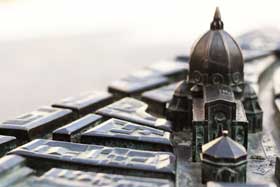
FLORENCE, capital of the region of Tuscany, has a population of around half a million inhabitants, spreads on the banks of the Arno, between the Adriatic and the Tyrrhenian seas, almost in the middle of the Italian peninsula. It is a city which bustles with industry and craft, commerce and culture, art and science. Being on the main national railway lines, it is easily accessible from most important places both in Italy and abroad. The Florence "Vespucci" airport, where both national and international airlines stop, is located 5 Km. from the city centre. The main motorway, A1, connects Florence with Bologna and Milano in the North and Rome and Naples in the South. The motorway A11 to the sea joins it to Prato, Pistoia, Montecatini, Lucca, Pisa and all the resorts on the Tyrrhenian sea. There is also motorway which connects Florence to Siena. The climate is temperate but rather variable, with breezy winters and hot summers.
The Chianti area, between Florence and Siena, is one of the most beautiful countrysides in Italy and a famous wine production area.
The city of Florence has many options when it comes to accommodation. You can find hotels, hostels and Florence apartments to rent to suit all styles and budgets. The city is a little expensive, but it's still possible to find hotels in Florence in good locations and save some money during your stay.

Founded by the Romans in the first century B.C., Florence began its rebirth after the decadence of the barbaric ages, in the Carolingian period, and reached its highest pinnacles of civilization between the 11th and 15th centuries, as a free city, balancing the authority of the Emperors with that of the Popes, overcoming the unfortunate internal dispute between Guelfs and Ghibellines. In the 15th century, it came under the rule of the Medici family, who later became the Grand Dukes of Tuscany. This in fact was the period when the city was at the height of its glory in art and culture, in politics and economic power. The Grand Duchy of the Medicis was succeeded, in the 18th century, by that of the House of Lorraine, when in 1860 Tuscany became part of the Kingdom of Italy of which Florence was the capital from 1865 to 1871. In this century, the city has once more taken up its role as an important centre for culture and the arts.
Read More: History of Florence
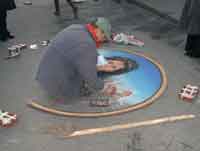
Florence contains an exceptional artistic patrimony, glorious testimony to its secular civilization. Cimabue and Giotto, the fathers of Italian painting, lived here, along with Arnolfo and Andrea Pisano, reformists of architecture and sculpture; Brunelleschi, Donatello and Masaccio, founders of the Renaissance; Ghiberti and the Della Robbia; Filippo Lippi and l'Angelico; Botticelli and Paolo Uccello; the universal geniuses Leonardo da Vinci and Michelangelo. Their works, along with those of many generations of artists up to the masters of the present century, are gathered in the city's many museums. In Florence, thanks to Dante, the Italian language was born; with Petrarch and Boccaccio literary studies were affirmed; with Humanism the philosophy and values of classical civilization were revived; with Machiavelli modern political science was born; with Guicciardini, historical prose; and with Galileo, modern experimental science. Up to the time of Charlemagne, Florence was a university town. Today it includes many specialized institutes and is an international cultural center. Academies, art schools, scientific institutes and cultural centers all contribute to the city's intense activity.
Read More: Art and culture of Florence

The economy of Florence is based mainly on the services sector, as the city is an important commercial centre. The traditional centuries-old banking and financial sector continues to flourish. Tourism and crafts (jewelry, embroidery, footwear, leatherwork, ceramics, wrought-iron and basket work, lace and reproduction furniture) provide considerable sources of income. The city is an active centre of culture, and organizes periodical exhibitions and art festivals. Industry, though consisting generally of small and medium-sized firms, has fairly important precision engineering, optical, pharmaceutical, chemical, metallurgical, publishing and textile sectors.
Read More: Economy of Florence

International Crafts Fair (April-May), Antiques Biennial, Music Festival in May, Opera and Theatre Seasons, Fashion shows (famous "Pitti" fairs, spring and autumn), Festival dei Popoli (December).
Read More: Events in Florence

The most important Folkloristic events in Florence are The "Burst of the Cart" (Easter), the Feast of St. John (June) and The "Historic Football in Costume" (June, July).
Read More: Folkloristic in Florence

Giovanni Cimabue (artist, 1240-1302), Dante Alighieri (poet, 1265-1321), Giovanni Boccaccio (poet, 1313-1375), Filippo Brunelleschi (architect, 1377-1446), Lorenzo Ghiberti (sculptor, 1378-1455), Donato dei Bardi, called 'il Donatello' (sculptor, 1386-1466), Luca della Robbia (sculptor, 1400-1482), Filippo Lippi (artist, 1406-1469), Antonio Pollaiolo (sculptor, 1432-1498), Alessandro Filipepi called 'il Botticelli' (artist, 1445-1510), Domenico Bigordi called 'Ghirlandaio' (artist, 1449-1494), Lorenzo the Magnificent (the most famous of the Medicis, 1449-1492), Leonardo da Vinci (artist, 1452-1519), Amerigo Vespucci (explorer who gave the name to the continent of America, 1454-1512), Michelangelo Buonarroti (artist, 1475-1564), Francesco Guicciardini (historian, 1483-1540), Andrea del Sarto (artist, 1486-1530), Niccolò Machiavelli (politician and historian, 1489-1527), Benvenuto Cellini (goldsmith, 1500-1571).


 Facebook
 Twitter
 Flickr
 Our Blog