The
building that is now seat of the Gallery was built
in the mid-sixteenth century by the architect Giorgio
Vasari (151 1-1574) in a period when Cosimo I de'
Medici, Grand Duke of Tuscany, was bureaucratically
consolidating this recently acquired position. The
building was meant in fact to house the offices of
the magistrates (Uffici=offices). From the beginning
however, the Medici set aside some of the rooms on
the third floor to house the finest works from their
collection. Two centuries later, thanks to the generosity
of the last heir of the family, Anna Maria Luisa,
their collection became permanent public property.
The
museum now comprises the rooms on the third floor
of the building, that display in chronological order
paintings ranging from the 13th to the 18th centuries.
The most precious and famous group of paintings of
the Uffizi are however represented by the works of
the Italian Renaissance artists, although several
sections of the museum are devoted to the works of
foreign artists (German, Flemish, Dutch and French).
In addition
to paintings, the Uffizi exhibits a fine collection
of Roman sculptures (portraits, emperors and divinities)
that are displayed in the corridors decorated with
frescoed and sculptured ceilings of the 16th and
17th centuries.
On the
ground floor it is still possible to admire the remains
of the ancient Romanesque church of San Piero Scheraggio,
which was partially destroyed by Vasari to build
the Uffizi. The second floor houses the Prints and
Drawings Department, which comprises one of the most
important collections in the world that was started
by a Medici, the Cardinal Leopoldo, during the 17th
century.
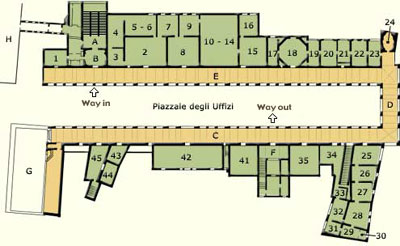
If we
follow the natural layout of the rooms, we enter
the large rooms that display the great altarpieces
of Cimabue, Giotto, Duccio di Buoninsegna, the first
remarkable examples of western painting, followed
by the remarkable works of 14th century Siennese
artists, such as Simone Martini and the brothers
Piero and Ambrogio Lorenzetti and the pupils of Giotto.
The following rooms display some fine examples of
the lnternational Gothic style: the Adoration of
the Magi by Gentile da Fabriano and another one by
Lorenzo Monaco, before actually reaching the most
important rooms of the museum that are dedicated
to the early Renaissance. These rooms exhibit works
by Masaccio, Paolo Uccello, Domenico Veneziano, Piero
della Francesca, Beato Angelico, followed by the
elegant Madonnas of Filippo Lippi, by the precious
panels of the brothers Piero and Antonio del Pollaiolo
to end with the mythological allegories and religious
paintings of Sandro Botticelli. Of this artist, the
museum preserves perhaps the finest colloction of
works, comprising the Birth of Venus, the Primavera,
the Magnificat and Pomegranate Madonnas.
It is
then the turn of Perugino, Signorelli, Piero di Cosimo
and Leonardo da Vinci; the latter is represented
both with the painting the Baptism of Christ painted
together with Verrocchio, the largeAdoration of the
Magi and his early work the Annunciation.
The
following rooms (from n. 18 to n. 23) are the oldest
of the museum; it is well worth stopping to admire
the Tribuna that originally contained the most precious
works and objects. Today it displays also a series
of portraits of the Medici family by Agnolo Bronzino,
in addition to the oldest sculpture piece of the
museum, the Medici Venus. The following rooms, originally
used as armouries, offer again more paintings by
Renaissance artists, both Italian - with works by
Bellini, Giorgione, Mantegna and Correggio - and
foreign artists with paintings by Dürer, Cranach,
Memling.
Continuing
along the rooms on the western side of the Gallery,
it is possible to admire more 16th century masterpieces,
starting trom the "Tondo Doni" by Michelangelo, the
Madonna of the goldfinch by Raphael and the Venus
of Urbin and Flora by Titian. Even the section dedicated
to Mannerism is lavish and comprises works by Pontormo,
Rosso Fiorentino, Bronzino down to Parmigianino (Madonna
with the lonq neck) and famous Venetian artists such
as Sebastiano del Piombo, Veronese, Tintoretto, and
Lombard ones like Savoldo and Moroni. Until not so
long ago the visit the the gallery ended with some
l 7th century works by famous Italian (Caravaggio,
Carracci) and Dutch (Rembrandt) artists. The museum
has recently restored the last rooms of this section
after the explosion of 1993, also in view of the
eniargement of the lower floors of the building that
were occupied by the State Archive until not so long
ago. The project for the "New Uffizi gallery", which
is already underway, will significantly alter the
original layout of the museum, doubling the exhibition
rooms. Thanks to this new arrangement it will be
possible to distribute more evenly works that are
now concentrated in a few rooms, exhibit paintings
that are now stored in the gallery's warehouses or
include whole collections that had to be displayed
elsewhere, like the Contini Bonacossi collection
(see below), due to lack of space. It is too early
to foresee the exact layout of the new gallery, althongh
it is certain that the collections will be arranged
in chronological order and by schools.
The
eastern section of the ground floor will be instead
used to welcome visitors and to house the bookshop,
with the rooms designed to offer a more confortable
and tidier approach to the large number of tourist
thet visit the Uffizi all the year round.
The
visit the the Gallery could ideally end with another
section: that is the famous Vasari Corridor, built
by Vasari in 1565. The Corridor joins the Uffizi
to Palazzo Vecchio, crosses the river Arno above
Ponte Vecchio and is connected with Palazzo Pitti
and the Boboli Gardens. Recently restored after the
explosion of the bomb, the corridor now displays
Down seven hundred works comprising mamly the Important
group of Self-portraits (from Andrea del Sarto to
Marc Chagall). At present the corridor can be visited
only by groups and by reserving the visit ahead.
|
|
|
Sandro Botticelli
The
Birth of Venus
|
|
|
|
Sandro Botticelli
The
Spring |
|
|
|
Tiziano
Flora
|
|
|
|
Bronzino
Eleonora
da Toledo |




 Façade by Vasari on river side


 Facebook
 Twitter
 Flickr
 Our Blog
 German
 French
 Spanish
 Italian
 Portuguese
 Czech
Czech Japanese