| |
The
typical Italian Gothic building, the Cathedral
of Florence, is dedicated to "Santa Maria
del Fiore". The church was designed by Arnolfo
di Cambio (c1245-1302) who considerably enlarged
the existing religious structure. Finished around
1367, the Cathedral was completely covered by
coloured marbles like the earlier Baptistery,
except for the façade that remained unfinished
and was terminated only in the 19th century.
The project left unfinished also the Dome, since
in 1421 only the frame (polygonal base) had been
erected. Two architects, Lorenzo Ghiberti (1368-1445)
and Filippo Brunelleschi (1377-1446) won the competition
although it was the latter who actually built
the dome, showing a great mastery of technical
knowledge, in 1436.
One of the most remarkable features of the outside
of the building is the socalled "Porta
della Mandorla"(north) (della mandorla
= almond) that was given this name because of
the large aureole around the figure of the Virgin
sculptured also by Nanni di Banco (1380/90-1421)
among others.
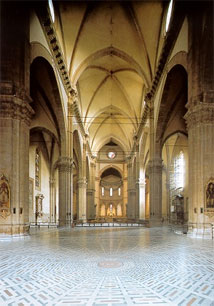
Its interior preserves very important works of
art: on the left side we find the first two detached
frescoes showing the "Condottiero Giovanni
Acuto"and "Niccolò da
Tolentino" painted respectively by Paolo
Uccello in 1436 and by Andrea del Castagno in
1456. Paolo Uccello also frescoed the clock on
the inside wall, showing four vogorous "heads
of saints". The many sculptures made
specifically for the cathedral (many of which
have now been moved to the "Museo dell«Opera
del Duomo"), comprise also the "Lunettes"
by Luca della Robbia above the doors of the Mass
Sacristies. The large "Pietà"
by Michelangelo (c. 1553) has instead been removed
and transferred to the "Museo dell«Opera
del Duomo".
Most of the splendid stained glass windows were
made between 1434 and 1455 to the designs of famous
artists like Donatello, Andrea del Castagno and
Paolo Uccello. The wooden inlays on the Sacristy«s
cupboards were designed by Brunelleschi and other
artists, including Antonio del Pollaiolo.
The internal walls of the dome, which have recently
been restored, were frescoed between 1572 and
1579 by Giorgio Vasari (1511-1574) and Federico
Zuccari (c. 1540-1609) who represented a large
scene of the "Final Judgement".
The bell tower by Giotto remains, together with
the hudge dome one of the most striking views
of the town. The famous painter, Giotto, was in
fact also the architect of the project for the
bell tower, although by the time of his death
(1337) only the lower part had been completed.
The works continued under the direction of Andrea
Pisano (c. 1290-1349) and Francesco Talenti (not.
1325-1369) who completed the project. |
|
|
|
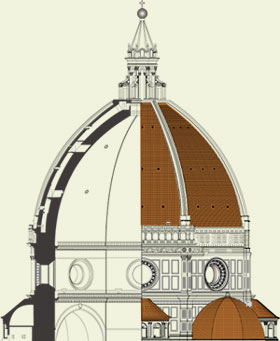
The
Brunelleschi Cupola
The cathedral was completed in 1434
and is the most important landmark in Florence,
as well as being the fourth largest
church in the world.
|
|
Giotto's
Belltower
|
|
|
|
|
inside
the cathedral Paolo Uccello painted
the clock face on the counter-façade
in 1446
The twenty-four hours are in Roman numerals
and counterclockwise according to the
position of the hours on sundials. |
|
|
|
|
The
reliefs in the lower row depict the
creation of man and woman, the
beginnings of human work, and the "inventors"
(according to the Bible) of various
creative activities:
sheep-herding, music, metallurgy, wine-making.
In the upper register are the 7 planets,
beginning with Jupiter at the north
corner.
On the other facades, in the lower register
we find astrology, building,
medicine, weaving and other technical
and
scientific endeavors.
In the upper registers are: on the south,
the theological and cardinal virtues;
on the east,
the liberal arts of the Trivium and
Quadrivium;
to the north,the
seven sacraments.
The statues in the niches represent
the patriarchs, prophets and kings
of Israel, and pagan sybils.
Originals can be found in the:
Musem
dell'Opera del Duomo
|
|
|
|
|
Inside
the cupola: 3600 m2 of frescos,
created by Giorgio Vasari and Federico
Zuccari,
who worked there from 1572 to 1579.
The restoration of these ceiling frescos
began
in 1978 and was completed in 1994. |
|
|
|
|
On
the right side of the square,
Brunelleschi is still looking up at his work |
|
|
|









 Facebook
 Twitter
 Flickr
 Our Blog
 German
 French
 Spanish
 Italian
 Portuguese
 Czech
Czech Japanese